Showing posts with label online marketing. Show all posts

Digital Marketing, Design and Development – Who Trumps Who?

The other day, someone in my network on Twitter tweeted a link to a very interesting article on Business Week titled The Value of Design to Startups. “Design and marketing are way more important than engineering for consumer Internet companies, argues angel investor Dave McClure

I really enjoyed the article because since my career has shifted into the online marketing side of things from the user experience side I’ve realised that many people within the digital media industry consider online marketing the weaker element of the online product.

I can’t even count how many times I’ve been in a meeting where a web developer has lectured me on how it’s impossible for someone in marketing to understand the complexity of the software or platform. No matter how many times the idea has been presented to me that I’m thick because I can’t write code I’ve never backed down or felt my contribution was insignificant. I might not code, but I am capable of understanding limitations as well as ways to exploit existing digital technologies. The idea that online marketing isn’t really tech is repugnant and ignorant.

Truth be told, there are a lot of bad marketers out there- especially within online because it’s so new and typically marketers tend to have a very rigid approach. Many marketers look at a project with assumptions based on proven strategies –which would be fine, but most new projects are entirely unique and there is no history for the marketer to use as a control.

I’ve worked on projects where the online marketing team has been invited into planning meetings in order to brainstorm requirements, and the best thing they could come up with was space for banner ads. I would argue that anyone who can’t come up with interactive and engaging elements is not an online marketer- they are an offline marketer that wasn’t able to get what they would consider a “real” job.

Anyway, back to Dave’s article and the point of this post.

Last night I was listening to Robin Goldberg speak at the Hive about Blurb. The technology on Blurb is not unique. Not even close to original. But the marketing is exceptional and the strategy to bring people together based on a passion, cause, creative spark or self promotion is genius. Walmart provides the same types of tools and there are lots of other places online to create your own photo book.

What makes Blurb different is the marketing and the brand positioning. Blurb is about community and expands into new territories as the community expands. When enough Australian’s started using Blurb, Robin got on a plane to make contacts and build up the community. The community on Blurb is the key to its success- not the technology.


I’m not entirely sure why there is snobbery amongst the digital media community regarding marketing. I’ve seen plenty of jokes about the hyper promotion of marketing and how we’re all being accosted by spam and badly run promotions, but I could equally throw stones in the other direction. I am so over badly organised websites. My pet hate is sites that are all style and no substance. The worst is landing on a page and thinking “how the hell do I find what I’m looking for and why the f*ck is every component riddled with bugs?”

There is good and bad in either side of the spectrum, but I will argue that we are all marketers. We market ourselves. We market our professions. We market our brands. Without marketing there would be no online business, and I would even venture as far to say that the Internet would not be half as significant in our daily lives.

Letter to a Client: eCommerce Design Tips

The following is an extract from an email I sent to a client today - I seem to share the same advise over and over, so why not post it with my readers?

...definitely bad etiquette having any sort of media start automatically. A glittery animation makes sense and will draw the eye to the rich content.

In terms of having a tag cloud- I do recommend these. Not only can you optimise more keywords, but most people don't perform searches in search boxes (unless they're conducting a search on Google or Yahoo) because most people lack trust in the internal search to propagate the content they're after (mostly because of semantics- you say tomato I say tamato). A tag cloud negates semantics and helps a user by serving up more ideas for items to look for.

If it comes down to needing to eliminate elements - the main rule of thumb is the bottom line "will this end in a sale?" - content for the sake of content is not more important then merchandise.

Also, in 4-6 months you'll likely want to make a few changes and modify certain elements. The canvas is never complete- there will be plenty of opportunities to make adjustments and refinements. The best way to determine what to keep and what to get rid of is the analytics from user behaviour- we can make all kinds of assumptions about what will have the most impact now, but the best director is consumer behaviour.

Metrics, Analytics & Goals

"You can’t improve what you don’t understand.” – Avinash Kaushik

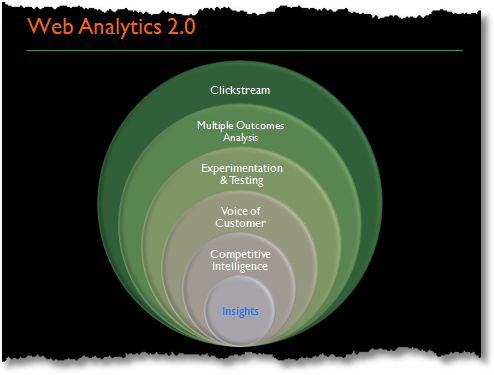
I've been reading a fantastic book this week that I highly recommend to anyone working within digital media analysis. Web Analytics 2.0, by Avinash Kaushik is a must-read for all online marketing professionals and business analysts.

Here's what I've taken away from my reading thus far:

Data is the anatomy of digital media. Within the structure of web platforms and online content is a wealth of information. It provides everything necessary to evaluate the sustainability of an online product. The challenge is not collecting data; but rather, in its evaluation and analysis. How and when decisions are made requires the right data at the right time. Timing is critical for proactive enhancements. By understanding the structure of digital media it is possible to improve the life of the product and the duration of its effectiveness.

The test and measure philosophy for success provides the awareness that no project is ever complete. It is crucial to acquire data that is actionable, and to discard data that is unhelpful or irrelevant. This principle seems simple, but assessing ‘good’ data from ‘bad’ data is unique to every web application, platform, and piece of content. Determining the KPIs (key performance indicators) requires trial and error.

Each individual within an organisation will have their own expectation for reporting based on their role and responsibilities. The role of the individual distributing these reports and evaluating them is determined by the company's corporate culture.

An administrator produces reports and distributes them to the individuals responsible for decision making. These managers evaluate the data and implement strategies based on the insights they extract. This causes delays and is not ideal for a start-up. A reporting system is better suited to a micro-management style of checks and balances, which slows down the decision making process.

The alternative is to employ an analyst who extracts insights based on their experience and industry knowledge. An analyst cuts down the time required for multiple individuals to reach a conclusion from the data. An analyst is suited to an agile development team that is trying to launch a new product. The difference is the speed in which decisions take place within the organisation. This report outlines the role of the analyst while detailing the necessary metrics to be collected and analysed.

Step 1: Customer Intent

This form of reporting is simple and standard with most analytics software. Essentially a few lines of code are added to each page; which is automatically generated by the analytics tool. This code will produce reports on general site-wide information, such as: page views and bounce rate. The core metrics listed above will be the basis for assessing the customer intent.


Step 2: Configure Settings

In order to asses “good” data from “bad” data the various conversion funnels will need to be stored within the analytics tool. These goals will allow us to determine how often a user performs specific actions that lead to positive outcomes; such as: completed registrations, subscribing to the newsletter, creating an ad, placing a bid, and even performing an internal search.
We need to capture the specific actions performed by each user in order to enhance and improve the sales funnel. Only through test and measurement of the online flows can processes be improved. If the majority of users are performing the same searches there may need to be a quick link provided upon point of entry to enhance the experience and serve relevant information directly.

Another important consideration is that not all actions will occur on the website. Thanks to open API's most users will be able to take action through external webpages and devices. Essentially, what the report needs to determine is how users are interacting with the platform (*think platform not website).

Step 3: Campaign Tracking

In order to accurately assess the ROI for online advertising and promotion it is critical that each and every Ad has a unique code associated with it. This includes emails, banners, referral links, and directory listings. The tag needs to include the location, source, and any other parameters surrounding the online marketing strategy for that particular promotion.

This requires time and a designated body assessing that the code is accurate and reports are verified. There are tools to help with the manual entry associated with campaign tracking, but it will require a person to manage and perform data entry.

It is very important to know where traffic is coming from and which referring websites are producing regular flows of traffic. The more relevant a promotion the higher the conversion rate which means a good return on investment. It’s important to determine which websites refer traffic based on internal search terms and top tags.

Step 4: Tracking Revenue & Intelligence

Additional JavaScript code will need to be embedded onto each page in order to extract data out of the page. The code will provide instructions for the script to know what data needs to be collected. Due to the fact that this data is personal and user generated it is important that all privacy measures have been taken into consideration. Legal evaluation of the data being collected is required; not only because of the user’s right to privacy, but because company data will be exported into an external tool and then processed into a report.

The value of this data is high and crucial for assessing gaps and accuracy of online forms, the payment gateway, and internal processes for user management. It is also required for measuring the payments being processed through your web platform.

Metrics to be collected include:
  • Daily Payments
  • Daily Fees Collected
Step 5: Event Tracking

Evaluating the effectiveness of rich media is paramount for any web 2.0 platform. Monitoring user interactions with content such as: videos, widgets, apps, audio, and any other user generated content. Developers will need to create and embed code into each piece of rich media content in order to track behaviour.

Reporting can include:
  • How often a video is played.
  • Viral distribution of content (sent via which aggregator)
  • How often a user opens an app
  • How often a user interacts via mobile device
  • Action via Widgets and Gadgets

Analytics Resources:
Google Analytics Glossary
Occam’s Razor by Avinah Kaushik
Hitwise
comScore
“Let data, not opinions, drive decisions.” – Avinash Kaushik

Selling Stuff Online

Recently a client came to us and asked how she could sell yoga DVDs online. We reviewed the category and looked at the competition and told our client that we could help her create a network in order to talk to people online about her style of yoga and the DVDs she produced.

The client wasn’t too thrilled initially, in fact, she downright hated the idea, but we held our ground. The thing of it is there is millions of yoga DVDs and differentiating one yoga DVD from the next is a hard nut to crack. I’ve tried a few yoga DVDs in my time, and I usually try the ones with the highest ratings on Amazon or whatever is being endorsed by celebrities like Gwyneth Paltrow or Madonna. Years ago I bought the NYC Ballet Company fitness DVD because Sarah Jessica Parker swore by it.

Lame as it might be, word of mouth is how most consumers make their buying decisions. Even if the recommendation comes from a total stranger it’s better than nothing. At least a rating and review provides some form of context. I also like being able to try before I buy. Video samples and video podcasts are a brilliant way to give potential customers a digital taste.

Anyway, during this time I was browsing through Mashable, and noticed a banner for a CMS platform called SocialGo. On the SocialGo website I found a case study for a site called Earthlings.

When the owners of Earthlings started their SocialGO network, they weren’t yet ready to sell their baby clothing products. Even so, they persevered and built a healthy, online community so that when they were ready to sell, they had constant access to a specifically targeted consumer base. “We thought, why not start a community? We can have the ball rolling even before we get our products online,” says Hannah Shone, Co-Owner of Earthlings.


There are a lot of online communities out there, and I think it’s a mistake for any company to think their online community is going to rival Facebook or Twitter – I can guarantee you that a corporate or brand community will never, ever surpass a community based on real-life connections.

Anyway, the goal is to integrate into existing communities and start a dialogue about something you’re passionate about. For my client, it was yoga and living a healthy, balanced lifestyle. This is the perfect kind of conversational fodder, and I imagined she’d take to it like a yogi to a mat. But I was wrong. My client followed my directions and created her own network on SocialGo, and created profiles on Facebook and Twitter. We had custom backgrounds made and showed her how to communicate with people. As a few months passed she arrived at my house looking glum and defeated. When I asked her what was going on she told me that she felt disappointed that no one had bought a DVD and no one on her SocialGo network was interacting.

I was shocked. It never occurred to me that I needed to explain that setting everything up was only the first step. The web is not a field of dreams – there is no “build it and they will come” mantra happening in the background.

First you need to interrupt someone, get their attention by offering them something they’re interested in or looking for, and then provide them that ‘thing’. Once you’ve got the ability to communicate with them and they feel satisfied that you delivered what they were looking for you can then start communicating with them about the next thing they want. Then you deliver that next thing, and so on. This goes on for awhile, and then one day you tell them about something new you’ve got before they even have to ask- why do you do this? Because you’ve developed a relationship, and you aren’t offering them something random- but something relevant and right up their alley.

I'll be blogging about this client adventure more over the next few weeks. Please add a comment or send an email if you have any questions or want to share your own experience with selling products online.

Steps for Implementing an Online Marketing Strategy

I’m very organized most of the time- not always, but my partner calls me the ‘keeper of all things’. I like knowing where all my stuff is and how to get at the small things at the back of the cupboard.

At work, I’m positive that I annoy most of my co-workers with my need to know everything. It’s not that I want to control everything or everyone- it’s just that I feel lost not knowing the bigger picture and it’s through the organization of the smaller things that I’m able to stay focused.

At home, if I want to try a new recipe from my favourite cookbook I don’t want to spend 20 minutes hunting for all the ingredients. I have a designated place for everything. All of my baking tools are in one drawer with all of the ingredients I use to bake.

Professionally, I apply the same principles to organizing strategies for my clients.

Here’s my list of actions and steps to keep a new project on-time and orderly. I strongly encourage you to leave a comment if you think I’ve missed anything or failed to explain something. I also encourage you to share this with anyone who might find it helpful.


Interview the client to obtain:
  • What are the business objectives?
  • What is the USP (unique selling proposition)?
  • What is the marketing budget (on-going and current)?
Research category to define:
  • Who are the direct competitors (online and offline)?
  • Are there any gaps in the market?
  • Are there any potential partners? (Cross promotions, affiliates, add-on services)
  • What is the best brand positioning strategy?
  • What are the top 40 search terms?
  • What available digital technology compliments the product/service?
Outline a project strategy to define:
  • Best method to achieve business goals.
  • Online brand positioning tactics.
  • Cost of acquisition via online promotion(s). (On-going, seasonal, special offers)
Content inventory assessment to define:
  • Is there enough call to action messages?
  • Are the calls to action messages strong enough and clear?
  • Are Images rotated and updated on a regular basis?
  • Is there a unique message for returning site visitors?
  • Can the sitemap be improved to increase traffic (SEO)?
  • Do people know what to do on the site? (Are the conversion paths smoothly transitioning the user through the flow?)
Work allocation to ensure:
  • Developer(s) understand what needs to be built and /or improved.
  • Designer is clear about the direction of the brand positioning.
  • Promotions are scheduled and prepared well in advance.
  • Copy is given a “fresh coat of paint” by a professional copy-writer.
On-going Analysis to obtain:
  • Report on performance translated into action (are people doing what we expected, is the number of conversions increasing?)
  • Explain the trends (annotate data with the wisdom that explains the results).
Another great idea when developing an online marketing strategy is to look at previous examples, 6 Lessons We Can Learn From Barack Obama’s Online Marketing Strategy.

Optimise All Content

If you had asked me a few years ago if I saw myself working in online marketing or SEO strategy I'd think you were bent - but here I am, in a role I never imagined for myself. I always thought I'd be working in some role that focused on the user experience. Coming from a forum and moderator background - being in the "trenches" is where I've always loved being. I think it's a great job to interact with people, find out what interests them and what they like and dislike about the platform or website content - and then working with the team that makes it the best user experience possible.

I assumed online marketing was just an old practice in a new media. Sometimes online marketing is a little like trying to fit a square peg in a round hole. I'm not a huge fan of AdWords and banner advertising - I think it's lazy to be honest and generally ineffective.

I guess because of my background and personality I want to create an experience for people online. I want interactive, fun, and if possible- inspiring capabilities that result in people having a good experience. To me, my job is about making it easy for the right audience to find the right content. That doesn't always mean a website- hence, AdWords and Banner Ads aren't always the right fit. Video is a great tool for just about any brand.

A great example comes from a post by a brilliant guy named Ian Lurie.

One innocent Tweet and everyone went nuts. Sheesh.

The YouTube Video Optimization session at SMX West today kicked butt. Out of many cool tidbits, one really stood out: Matt Ballek pointed out a Forrester study showing that an optimized YouTube video is 50x more likely to get onto page 1 of Google than an optimized HTML page.

I tweeted it. It then got retweeted. And retweeted again. And then some more. And so on.

Since it got a lot of attention, I figured I'd better provide a proper citation. Matt was referencing a Forrester report that said:

Now that's a lot of math, but here's what it means: on the keywords for which Google offers video results, any given video in the index stands about a 50 times better chance of appearing on the first page of results than any given text page in the index.

Matt's presentation was dynamite. Learn more from him on his site, vidiSEO.


I think it's a great point to raise - SEO is about optimised content. As much as it's good practice to optimise a website it's just as important to optimise each piece of media you create.