Showing posts with label online marketing strategy. Show all posts

Storytelling Sells

According to Seth Godin, there are eleven criteria of a great story:
  1. Great stories succeed because they are able to capture the imagination of large or important audiences.
  2. A great story is true. Not necessarily because it’s factual, but because it’s consistent and authentic. Consumers are too good at sniffing out inconsistencies for a marketer to get away with a story that’s just slapped on.
  3. Great stories make a promise. They promise fun, safety or a shortcut. The promise needs to be bold and audacious. It’s either exceptional or it’s not worth listening to.
  4. Great stories are trusted. Trust is the scarcest resource we’ve got left. No one trusts anyone. People don’t trust the beautiful women ordering vodka at the corner bar (they’re getting paid by the liquor company). People don’t trust the spokespeople on commercials (who exactly is Rula Lenska?). And they certainly don’t trust the companies that make pharmaceuticals (Vioxx, apparently, can kill you). As a result, no marketer succeeds in telling a story unless he has earned the credibility to tell that story.
  5. Great stories are subtle. Surprisingly, the fewer details a marketer spells out, the more powerful the story becomes. Talented marketers understand that allowing people to draw their own conclusions is far more effective than announcing the punch line.
  6. Great stories happen fast. First impressions are far more powerful than we give them credit for.
  7. Great stories don’t always need eight-page color brochures or a face-to-face meeting. Either you are ready to listen or you aren’t.
  8. Great stories don’t appeal to logic, but they often appeal to our senses. Pheromones aren’t a myth. People decide if they like someone after just a sniff.
  9. Great stories are rarely aimed at everyone. Average people are good at ignoring you. Average people have too many different points of view about life and average people are by and large satisfied. If you need to water down your story to appeal to everyone, it will appeal to no one. The most effective stories match the world view of a tiny audience—and then that tiny audience spreads the story.
  10. Great stories don’t contradict themselves. If your restaurant is in the right location but had the wrong menu, you lose. If your art gallery carries the right artists but your staff is made up of rejects from a used car lot, you lose. Consumers are clever and they’ll see through your deceit at once.
  11. Most of all, great stories agree with our world view. The best stories don’t teach people anything new. Instead, the best stories agree with what the audience already believes and makes the members of the audience feel smart and secure when reminded how right they were in the first place.
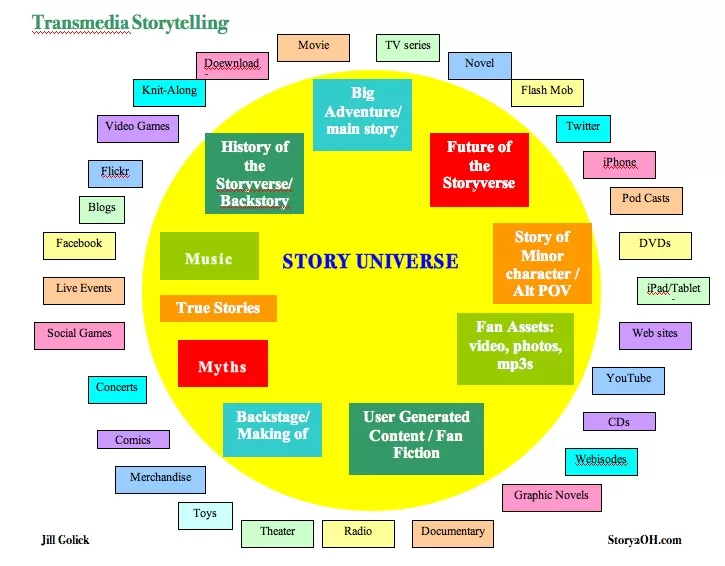
As more and more companies jump into the social media pool they need to ask themselves what story they want to tell. I think the best story is a chose your own adventure.

Image by Idris Mootee

Online Community ROI

Occasionally I’m asked to explain what the purpose of social media is for individuals and businesses. Too often I’m greeted by sceptical views and a strong belief that social media encourages people to waste time. First of all, TV wastes time. Social media enables participation.
As Clay Skirky points out in Cognitive Surplus, “Someone born in 1960 has watched something like 50,000 hours of TV already, and may watch another 30,000 hours before she dies.”
Clearly, we have an excess of time. We are idle when taking the train to work. We are idle after dinner and once the kids are in bed. Despite our good intentions of maximizing our twilight years we tend to find other things to do rather than build that boat or write a novel. As much as we’d like to believe that we are all making the most of all of the hours in the day we do have some form of down time and it’s within this time that people chose to participate online.

The return on investment is the part that many businesses struggle to define. In meetings online community advocates are shouted at by finance to, “show me the money!” Top dogs want proof before business as usual gets derailed.

Here are a few quick facts to throw into your next presentation:
  • Community users remain customers 50% longer than non-community users. (AT&T, 2002)
  • 43% of support forums visits are in lieu of opening up a support case. (Cisco, 2004).
  • Community users spend 54% more than non-community users (EBay, 2006)
  • In customer support, live interaction costs 87% more per transaction on average than forums and other web self-service options. (ASP, 2002)
  • Cost per interaction in customers support averages $12 via the contact center versus $0.25 via self-service options. (Forrester, 2006)
  • Community users visit nine times more often than non-community users (McKInsey, 2000).
  • Community users have four times as many page views as non-community users (McKInsey, 2000).
  • 56% percent of online community members log in once a day or more (Annenberg, 2007)
  • Customers report good experiences in forums more than twice as often as they do via calls or mail. (Jupiter, 2006)
Statistics provided by Bill Johnston

The simple truth is that consumers don’t want to be passive. We don’t buy something these days without doing a little research. We ask our friends and family what they recommend. We ask our co-workers and post on Facebook or forums. We have access to our own “experts” who know us better than any marketer. In a world overwrought with too many products and services competing for our attention we need more information as consumers to make informed decisions.

The psychology of the consumer can no longer be assumed. How a product is used is not always how it’s advertised and the ROI of opening up a dialogue is discovering the true potential and reach of a commodity. Brand longevity is a result of faster processes to address customer service issues and quicker innovation. Customer loyalty is possible when brands are transparent and stop taking their customers for granted. By inviting consumers into the production space fewer advertising costs are incurred.

Think about how an online community could improve your business:
  • How many customers do you lose because your current processes don’t allow you to respond fast enough?
  • How much do you spend on advertising to new customers?
  • What would change if you focused on empowering existing customers to spread the word instead of expensive TV or print campaigns?
  • Can your community members answer customer’s questions for you?

Facebook Tips for Brand Managers


I just came accross this on Facebook's Marketing Fan Page. It is one of several reference papers published by Facebook to help marketers and business owners use Facebook effectively.

Check it out:
Using Facebook to move your business forward

Find Facebook on Scribd

How to get started in Social Media Marketing: Start Listening

The following is a list of activities I've learned from personal experience, as well as, reading books such as Web Marketing for Dummies

Unlike other forms of advertising and promotions, social media marketing is not interruption based, but permission based. We have been social creatures since the days of cavemen and one of our earliest inventions was language development. Knowing how to effectively communicate begins with active listening.

In order for your strategy to make an impact it needs to follow trends, know where your target audience spends their time online, and how to communicate about your products and services without spamming people or getting blocked from networking platforms.

Step 1: Become open-minded.

Understand that assumptions are not facts. Most businesses end up speaking to their existing partners and co-workers online. This is great if your goal is peer-building, but it’s not going to increase your online presence. Do not use offline data to market your brand online. Do not assume that everyone is like you. Do not treat your online activities as a waste of time or insignificant. (Most people can pick up on negative or passive-aggressive attitudes and it is not a good first impression.)

Begin your research understanding that you know nothing- that way your current opinions can’t cloud your judgement and lead you down the wrong path.

Step 2: Put your ear to the ground.

The easiest way to start listening is to create a listening desktop. I recommend that you use iGoogle to manage all of the blogs and RSS feeds you follow in relation to your company and category. If you don’t have a gmail account it’s easy and free to set one up. Once you’ve logged into your iGoogle homepage you can start adding blogs and RSS feeds to keep track of on a daily basis. You can also add keyword searches to iGoogle.

Other examples include: competitor names, individuals in your company, product names, etc.

Other things to track include:
  • Twitter feeds or search results
  • News search results
  • YouTube
  • Flickr
  • Yahoo Answers
Step 3: Keep a log

Using Excel, create a worksheet that tracks audience data and social media sites where your brand and category is being discussed or commented on.

Audience data:
What kind of people are in your audience?
  • Age
  • Gender
  • Income
  • Children
  • Regions
  • Ethnicity
Other notes to log: Why are they participating in the community or group? What communities or sites do they most often use? How big is this audience? How often do they participate? Who is most influential? Who has the most followers and participants?

Keyword data:
  • Phrase
  • Age
  • Male/Female
Examples of online communities to research:
  • Google Groups
  • Yahoo Groups
  • Facebook
  • Digg
  • Blogger
  • Wordpress
Other resources for free research:
adCenter Labs http://adlab.msn.com
Quantcast www.quantcast.com

Other resources for paid research:
Nielsen Online www.nielsen-online.com
Hitwise www.hitwise.com
Compete http://compete.com
Comscore www.comscore.com
Forester www.forrester.com

Step 4: Start asking questions

There are many free tools to help you ask questions. Yahoo Answers allows anyone to ask and answer, but they don’t necessarily reflect your target audience. LinkedIn allows you to specify the category of your question and narrow down whom you’d like answers from within the LinkedIn community.

Another great resource for creating a free online survey is Google documents. If you’d prefer to have a more professional service conduct a survey on your behalf is to use something like www.surveymonkey.com.

Step 5: Review Google Analytics

Look at how visitors are behaving on your site. Note which pages are popular and visitors spend time on. Begin to think about how the topics of these pages can be incorporated into your social media marketing plan.

Step 6: Compile findings

Take all of the data and research collected and decide how to start engaging in social media to extend your brand presence online.

Step 7: Design a Digital Social Media Policy

Your social media policy serves, in its simplest form, as a guide to how a business, its employees, and anyone else speaking on behalf of the business should share opinions, beliefs, and recommendations with customers online. It is important to have this in place before you engage your staff to represent your brand. Learn more from WOMMA (Word of Mouth Marketing Association).